

Vinyl mastering: a master ready for cutting
A master built for streaming doesn’t always work as it is on a record. On vinyl, sound becomes a groove: low end moves the cutting stylus sideways and vertically, high end demands acceleration, and level is paid for in side length. A master that is too compressed, too bright or too wide in the low end forces the cutting engineer to lower the level, or produces distortion on playback.
The vinyl master takes your mastering and reworks it with these constraints in mind. It is a €15 option, available on stereo mastering, stem mastering and mixing + mastering.
What changes for vinyl
Low end in mono
Below a certain frequency, the low end has to be centered. A bass or a kick spread in stereo, or out of phase, turns into vertical movement of the groove that can make the stylus jump. We re-center the low end and check phase over the whole length of the track.
Sibilance and high end
The “s” sounds of a voice, cymbals and very bright synthesizers are the hardest parts to cut and to track. We control them dynamically, notably with the Maselec MDS-2, so we only act when they exceed the limit.
Level and dynamics
A record doesn’t need a high level: it is the listener’s turntable that sets the playback volume. The vinyl master therefore keeps more dynamics than the digital version, without a pushed limiter, which leaves the cutting engineer room to do their job.
Length and side order
The longer a side, the tighter the groove has to be, and the lower the cut level. The end of a side, near the center, is also where high frequencies reproduce least well: the calmest tracks are best placed there.
| Format | Time per side (guide) |
|---|---|
| 12″ (30 cm), 33 rpm | up to about 18–20 minutes |
| 12″ (30 cm), 45 rpm | up to about 12 minutes |
| 10″ (25 cm), 33 rpm | up to about 12–14 minutes |
| 7″ (17 cm), 45 rpm | up to about 4–5 minutes |
These durations are guidelines: your pressing plant or cutting engineer will give you their own limits, to check before you lock the running order.
What we deliver to the plant
Each plant and each cutting engineer has its own requirements: files per side or per track, resolution, a spec sheet with the order and length of the tracks. We deliver the files exactly in the format they ask for. Send us their instructions with your order.
We don’t cut the lacquers ourselves: cutting is done by the cutting engineer or pressing plant you have chosen.
Reissuing an old record
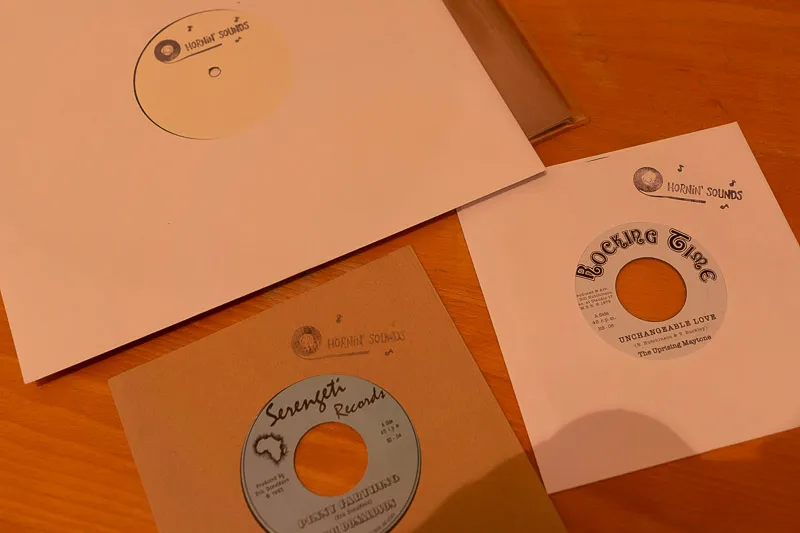
For the reggae label Hornin’ Sounds, we remastered extremely rare 1970s records, of which fewer than 200 copies are still around. Each record was first cleaned with products suited to its age, then digitized with a Technics SL-1200 MK2 turntable and an audiophile stylus, through our analog mastering chain. The crackle and the damage caused by wear and the original pressing were then treated one by one, before the masters were delivered to the pressing plant for the reissue.
If you are preparing a reissue from records or tapes, see also audio restoration.
Price
The vinyl master option costs €15 per track, on top of the mastering you choose:
- Stereo mastering: €70 + €15
- Stem mastering: €110 + €15
- Mixing + mastering: from €160 to €310 + €15
Frequently asked questions
Do I really need a separate master for vinyl?
Yes, as soon as the digital master is loud, bright or wide in the low end, which is the case for most current releases. The vinyl master saves the cutting engineer from having to correct it themselves.
How many minutes per side?
For a 12″ at 33 rpm, aim for 18 to 20 minutes at most per side. Beyond that, the cut level drops and surface noise becomes more present. Your plant will confirm its limits.
Do you cut the lacquers?
No. We prepare and deliver the files; cutting is done by the cutting engineer or pressing plant.
A track to finish?
Start your project online, or write to the studio about an album, a film or a restoration.